Choosing the right pump is essential for maintaining consistent fluid transfer and dosing performance in commercial and industrial equipment. Whether your application involves beverage dispensing, cleaning chemicals, laboratory samples or water treatment, the pump must match your operating requirements.
A LEFOO peristaltic pump can be a practical solution for applications requiring controlled liquid movement through flexible tubing. LEFOO manufactures different pump configurations designed for various flow rates, tubing materials and control requirements.
However, selecting the right model involves more than checking its maximum flow capacity.
This guide explains the important factors to consider when choosing a LEFOO peristaltic pump for your equipment.
What Is a LEFOO Peristaltic Pump?
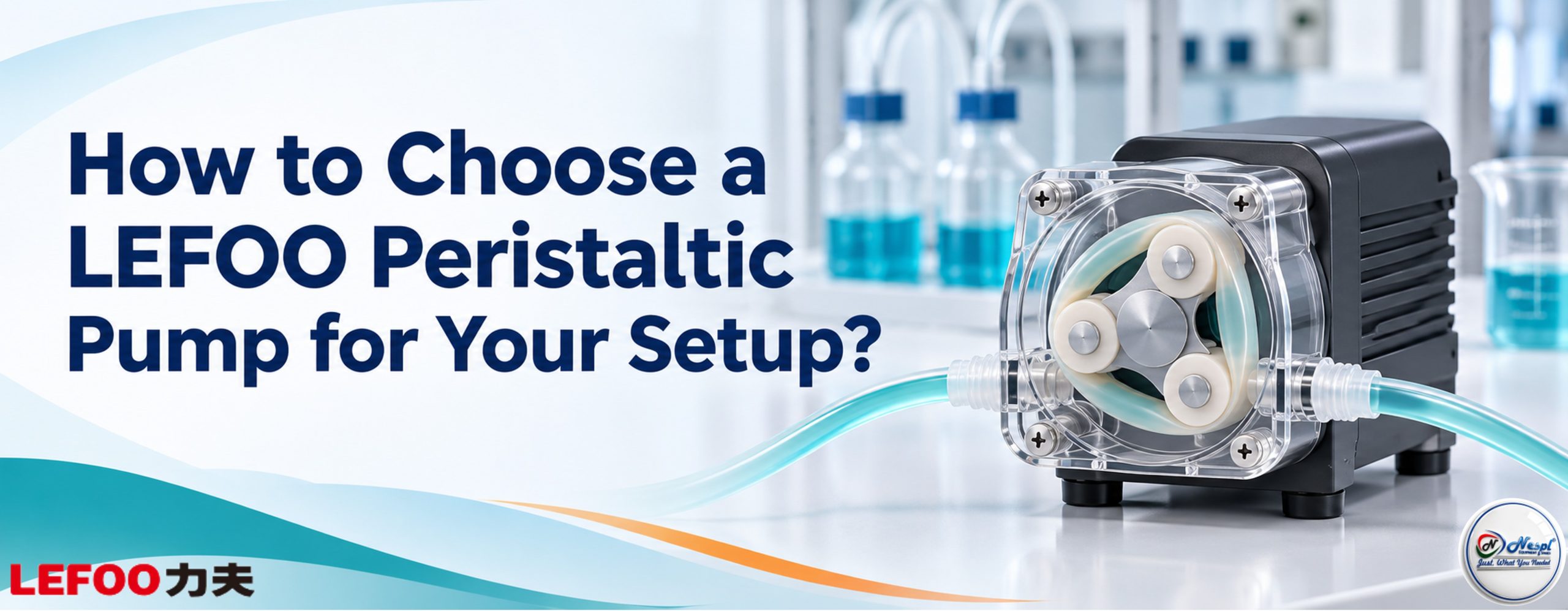
A Lefoo peristaltic pump is a positive-displacement pump that transfers liquid by compressing flexible tubing.
Inside the pump head, rotating rollers repeatedly squeeze and release the tube, pushing the liquid through the fluid pathway.
One advantage of this design is that the liquid remains inside the tubing rather than flowing directly through the pump’s internal drive mechanism.
This makes tubing selection particularly important because it is the primary material in contact with the fluid.
LEFOO offers peristaltic pump configurations for dosing and fluid transfer applications, including compact DC motor and stepper motor models.
These pumps may be suitable for beverage equipment, laboratory instruments, automated cleaning systems and other compatible fluid-handling installations.
1. Determine Your Required Flow Rate
The first step in selecting a LEFOO peristaltic pump is identifying how much liquid your system needs to transfer.
Flow rate is generally measured in millilitres per minute (mL/min) or litres per hour (L/h).
For continuous fluid transfer, calculate the required volume over a particular operating period.
For dispensing applications, determine the amount of liquid required per dose and the time available for delivery.
Example of Flow Rate Calculation
Suppose a beverage dispensing system needs to transfer 50 mL of liquid in 30 seconds.
The average required flow rate would be:
50 mL ÷ 0.5 minute = 100 mL/min
This provides a useful starting point for comparing different pump configurations.
However, the published flow rate may vary depending on tubing size, motor speed, fluid characteristics and installation conditions.
LEFOO offers different pump series with different performance specifications. Always compare the exact model and tubing configuration rather than selecting a pump based only on an advertised maximum flow value.
2. Select the Correct Tubing Material
Tubing selection is one of the most important factors affecting peristaltic pump performance.
Because the liquid travels through flexible tubing, the tube material must be compatible with the fluid being transferred.
Before selecting a material, consider the liquid’s chemical composition, concentration, viscosity and operating temperature.
LEFOO specifications for certain models include options such as silicone, BPT, A60-F and Viton tubing.
These materials have different chemical and mechanical properties and should not be treated as interchangeable.
Silicone Tubing
Silicone tubing is commonly used in suitable fluid-transfer applications requiring flexibility.
For food and beverage equipment, confirm that the specific tubing grade meets the relevant food-contact requirements.
Specialised Chemical-Resistant Tubing
Cleaning chemicals, detergents and other aggressive liquids may require specially formulated tubing.
Materials such as Viton or other compatible options may be considered, depending on the manufacturer’s chemical resistance information.
No tubing material should be assumed suitable for every chemical or concentration.
Always verify compatibility before installation.
3. Choose the Right Motor Type
LEFOO offers different motor configurations to support varying operating requirements.
The correct motor depends on whether your system needs straightforward fluid transfer or more adjustable control.
DC Motor Peristaltic Pumps
DC motor configurations can be suitable for applications involving fixed-speed transfer or timed dispensing.
They may be useful in equipment where an external controller manages the pump’s operating time.
Stepper Motor Peristaltic Pumps
Stepper motor configurations may provide adjustable speed and more flexible operating control.
For example, LEFOO’s LFP101/ST documentation describes functions such as speed adjustment and forward or reverse operation, depending on the selected configuration.
These features may be useful where controlled dispensing is important.
However, customers should confirm whether the required motor driver, control board and related functions are included with the exact pump model.
4. Check Fluid Viscosity and Pressure Conditions
The characteristics of the liquid and the installation can affect actual pump output.
For example, transferring water may require different operating conditions from transferring concentrated syrup or viscous cleaning chemicals.
Important factors include:
- Liquid viscosity: Thick liquids may affect the pump’s delivery performance.
- Suction lift: The distance between the liquid source and pump can influence flow.
- Discharge pressure: Restrictions downstream can affect output.
- Tubing length: Long tubing runs and additional fittings may increase resistance.
- Operating temperature: Temperature changes can influence liquid properties and tubing behaviour.
A suitable pump should meet the application’s requirements under real operating conditions.
For applications requiring accurate dosing, performance should be checked using the actual liquid and installed tubing.
5. Verify Electrical Compatibility
Electrical specifications are essential when selecting a pump for commercial or industrial equipment.
LEFOO offers selected peristaltic pump models in different voltage configurations, including 12V DC and 24V DC options.
Before purchasing, verify the operating voltage, power requirements, electrical connections and motor-control arrangement.
If replacing an existing pump, compare the new unit’s specifications with the original model.
A pump with similar dimensions may still be unsuitable if its voltage or control requirements differ.
Matching the electrical design helps avoid installation problems and supports dependable operation.
6. Check Installation Space and Mounting Requirements
A pump must fit correctly inside the equipment where it will operate.
Before selecting a model, review its dimensions, mounting arrangement, tubing connections and available service access.
Some LEFOO pumps are designed for compact installations and include mounting holes for integration into equipment.
However, mounting arrangements differ by model.
Ensure the selected pump can be installed according to the manufacturer’s requirements without restricting access to its tubing or pump head.
This is particularly important in beverage dispensers, automated cleaning equipment and laboratory instruments where installation space may be limited.
7. Consider Duty Cycle and Maintenance
A pump used occasionally for dispensing may have different requirements from a pump expected to operate for extended periods.
Check whether the selected model supports the intended operating schedule.
Also consider future servicing.
Peristaltic tubing experiences repeated mechanical compression during operation and will eventually require inspection or replacement.
Tubing wear can affect flow performance, making maintenance an important consideration for applications requiring consistent dosing.
Before purchasing, check the availability of replacement tubing and other model-specific service components.
Buy LEFOO Peristaltic Pumps From NESPL in India
At Natron Equipment & Spares Pvt. Ltd. (NESPL), we supply LEFOO peristaltic pumps in India, helping businesses source reliable fluid-handling components for their commercial and industrial equipment.
Our product range includes several LEFOO pump models, such as the LFP404DB, LFP303A/DB, LFP203/DB, LFP202/DB and LFP101A/DB. These models offer different configurations to meet varying fluid-handling and application requirements.
We assist equipment manufacturers, maintenance professionals and purchasing teams with product identification and sourcing enquiries to help them find suitable pump options for their applications.
To help us identify the right pump for your requirements, please share details such as the required flow rate, pump model, voltage, tubing material, liquid specifications and expected operating conditions.
If you are looking for a replacement pump, sharing the existing model number or a clear photograph of the product label can also help us identify the correct replacement.
For product specifications, availability and quotations, get in touch with us at sales3@natronequipments.com. Our team will be happy to assist you with your requirements.
Conclusion
Choosing the right LEFOO peristaltic pump requires careful evaluation of flow rate, tubing compatibility, motor configuration, electrical specifications and installation requirements.
The best pump is not necessarily the model with the highest flow capacity. It is the one that matches the application’s liquid-handling and operating conditions.
By verifying technical specifications and planning for maintenance, businesses can select pumps more confidently and support consistent equipment performance.
We help businesses across India source LEFOO peristaltic pumps by offering access to our range of listed models, along with product identification and sourcing assistance.
Must visit to buy: https://www.natronequipments.com/brand/lefoo/peristaltic-pump
Frequently Asked Questions About LEFOO Peristaltic Pumps
1. What are LEFOO peristaltic pumps used for?
LEFOO peristaltic pumps are used for controlled fluid transfer and dosing in compatible beverage dispensing, laboratory, cleaning, water treatment and industrial equipment applications.
2. How do I choose the correct LEFOO peristaltic pump?
Start by identifying the required flow rate, liquid characteristics, tubing material, operating voltage and installation conditions. Then compare those requirements with the specifications of the exact LEFOO model.
3. Can LEFOO peristaltic pumps handle chemicals?
Certain configurations may be suitable for chemical transfer or dosing. However, the tubing material must be compatible with the specific chemical, its concentration and the operating temperature.
4. What is the difference between DC and stepper motor peristaltic pumps?
DC motor pumps can suit straightforward transfer or timed dispensing applications. Stepper motor configurations can provide adjustable speed control when used with the appropriate electronics.