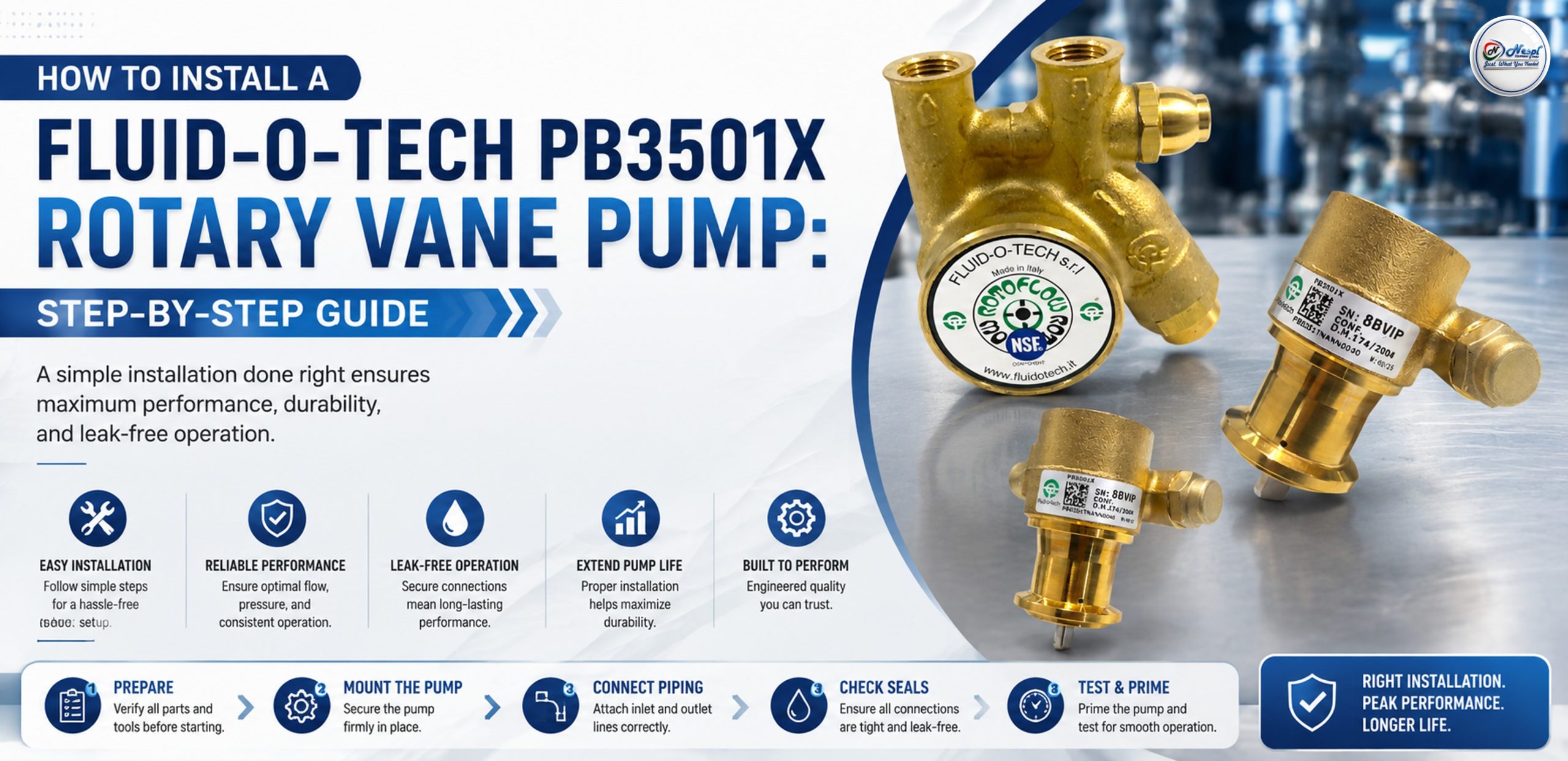
The Fluid-o-Tech PB3501X is a professional rotary vane pump designed for applications that require reliable liquid transfer and consistent pressure. Correct installation is essential for reducing vibration, preventing leaks, protecting the hydraulic circuit, and supporting dependable pump performance.
Installation should be carried out by qualified personnel familiar with mechanical, hydraulic, and electrical systems. Things to Consider First, always verify the exact PB3501X configuration, operating limits, fittings, motor arrangement, and application requirements against the relevant Fluid-o-Tech documentation.
For any doubt & Query write us at: sales3@natronequipments.com
Before Installation
Before installing the pump, confirm the exact model and configuration, inlet and outlet ports, thread type, motor compatibility, operating pressure, expected flow, application fluid, and temperature range. Do not assume that a visually similar Fluid-o-Tech pump is a direct replacement, as different models can have different capacities, connections, materials, and operating characteristics.
Depending on the installation, you may also need suitable mounting hardware, compatible pipe fittings and tubing, an inlet filter, a pressure gauge, appropriate safety or relief devices, hand tools, electrical tools, and clean commissioning fluid.
Step 1: Inspect the Pump
Before installation, carefully inspect the pump for shipping damage, cracks, damaged threads, contamination, missing components, shaft or coupling damage, incorrect fittings, or an incorrect model.
Keep the protective caps on the inlet and outlet ports until the system is ready to be connected. This helps prevent dust, debris, and other contaminants from entering the pump.
Step 2: Choose a Suitable Installation Location
Choose a location that provides adequate ventilation, stable support, easy access for maintenance, and practical pipe routing. The pump should be positioned where unnecessary vibration and excessive heat can be avoided.
Avoid enclosed locations that may restrict airflow or trap heat around the motor and pump assembly.
Step 3: Mount the Pump Correctly
Fluid-o-Tech guidance for rotary-vane pump and motor units specifies horizontal mounting. Install the pump on a stable surface using suitable mounting hardware.
Where appropriate, vibration-damping supports can help reduce mechanical vibration and operating noise. The connected pipework should also be independently supported so that its weight or movement does not place excessive stress on the pump ports.
Step 4: Confirm the Inlet and Outlet
Before connecting any pipework, identify the suction inlet and discharge outlet. Do not rely solely on the appearance of another pump or a previous installation, as port arrangements can vary between models.
Incorrect inlet and outlet connections can prevent the pump from operating correctly and may cause performance or system issues.
Step 5: Select the Correct Fittings
Selecting the correct fittings is essential for a secure and leak-free installation. Fluid-o-Tech notes that similar-looking pumps may use different thread types, including GAS and NPT.
Always match the fitting to the exact pump-port thread. Check the thread standard and size, fitting material, pressure rating, temperature rating, tubing compatibility, and sealing requirements before installation.
Never force an incompatible fitting into the pump port, as this can damage the threads and result in leaks or other problems.
Step 6: Install the Inlet Line
Keep the suction line as short as practical and use an appropriately sized pipe or tube. The inlet line should be properly sealed and routed without unnecessary restrictions, sharp bends, or sudden changes in direction.
Excessive restriction on the suction side can contribute to cavitation, increased noise, reduced flow, and premature pump wear. Fluid-o-Tech recommends using suitable pipe sizes and positioning the pump close to the supply tank where practical.
Step 7: Clean and Filter the Circuit
Before connecting the final hydraulic circuit, carefully flush the pipework to remove dust, metal particles, sealant residue, and other contaminants that could enter the pump.
Install an appropriately selected inlet filter where required. The filter should protect the pump from contamination without creating excessive resistance on the suction side.
Clean hydraulic circuits are particularly important when installing or replacing a pump, as contamination can affect pump performance and service life.
Step 8: Connect the Outlet
Connect the discharge line using the correct fitting for the pump and application. Support the discharge pipework independently and make sure the tubing is properly routed without kinks or unnecessary restrictions.
Before starting the pump, confirm that the expected system pressure remains within the specified operating limits for the exact PB3501X configuration.
Step 9: Add Appropriate Pressure Protection
A rotary vane pump should not be operated against uncontrolled excessive pressure. Depending on the application, the system may require a relief valve, pressure switch, pressure gauge, or another suitable safety device.
Any pressure protection device should be selected and configured according to the exact PB3501X specification and the requirements of the application. Do not use a generic rotary-pump pressure value as a substitute for the manufacturer’s specifications.
Step 10: Check the Motor and Coupling
If the PB3501X is being paired with a motor, verify the motor voltage, frequency, RPM, shaft dimensions, coupling, alignment, and rotation direction before commissioning the system.
Do not select a motor simply because its shaft appears to fit. The motor and pump must be compatible with the intended application and operating conditions.
Check that the pump and motor shafts are correctly aligned and that the coupling turns freely where the design permits. Misalignment can result in vibration, noise, coupling wear, bearing stress, seal problems, and reduced service life.
Step 11: Prime the Pump
Make sure the supply tank contains a sufficient amount of approved liquid and that the inlet path is open. Remove trapped air where the system design allows.
Do not assume that every rotary vane pump can tolerate dry running. Follow the appropriate Fluid-o-Tech commissioning procedure for the exact pump configuration before starting the unit.
Step 12: Start the Pump and Observe Its Operation
Before initial start-up, check the mounting, electrical connections, liquid supply, inlet and outlet connections, and pressure protection.
Start the pump and immediately check for leaks, unusual noise, excessive vibration, unstable pressure, or inadequate flow. If anything appears abnormal, stop the system and investigate the cause before continuing operation.
Step 13: Verify Pump Performance
Once the system is operating steadily, check the expected flow, operating pressure, motor current where appropriate, temperature, vibration, noise, and pressure stability.
Always use the performance data for the exact Fluid-o-Tech PB3501X configuration rather than relying on general rotary-vane-pump specifications.
Highly Recommended: https://www.natronequipments.com/various-industry-products/products-by-industry/water-treatment/pa01x-rotary-vane-pump-nssp001096.html
Common Installation Mistakes to Avoid
Several common installation mistakes can affect pump performance and service life. These include using a pump with the wrong capacity, mixing thread standards, restricting the suction line, failing to flush the hydraulic circuit, providing inadequate ventilation, starting the pump without an adequate liquid supply, and continuing to operate the pump despite unusual noise or vibration.
Taking the time to verify the installation before commissioning can help prevent avoidable leaks, performance problems, and premature component wear.
Maintenance Tips for Long-Term Performance
Regular maintenance can help keep the pump and hydraulic system operating reliably. Inspect the pipe and tubing connections, filters, pressure settings, mounting hardware, motor, coupling, and seals regularly. Also monitor the system for leaks, unusual vibration, changes in flow, abnormal noise, and pressure fluctuations.
The maintenance schedule should take into account operating hours, fluid quality, temperature, pressure, and the recommendations provided by the manufacturer.
Why Choose Natron Equipment & Spares Pvt. Ltd. (NESPL) for Fluid-o-Tech Pumps and Components?
Choosing the correct pump is just as important as installing it correctly. The right model, configuration, fittings, and replacement components need to match the requirements of the application.
Natron Equipment & Spares Pvt. Ltd. (NESPL) supplies Fluid-o-Tech pumps and related components for a wide range of fluid handling applications. We work with OEMs, equipment manufacturers, system integrators, service providers, and industrial customers looking for reliable fluid handling solutions.
Our product range includes Fluid-o-Tech rotary vane pumps, pump components, replacement parts, fittings, and other fluid handling products. Our team can assist customers with product identification and help them source the appropriate components based on their equipment and application requirements.
When replacing an existing pump or sourcing components for a new system, providing details such as the pump model, configuration, application, required flow, operating pressure, and existing component information can help ensure the right product is selected.
Conclusion
Installing a Fluid-o-Tech PB3501X rotary vane pump correctly involves more than simply connecting the inlet and outlet lines. Proper model selection, mounting, thread and fitting compatibility, clean pipework, appropriate filtration, pressure protection, motor alignment, priming, and controlled commissioning all contribute to reliable pump operation.
Following the manufacturer’s documentation and using the correct components can help reduce installation problems, minimize downtime, and support the long-term performance of the pump and the wider hydraulic system.
If you’re looking for Fluid-o-Tech rotary vane pumps, replacement parts, or related fluid handling components, Natron Equipment & Spares Pvt. Ltd. (NESPL) can help you identify and source the right products for your application.