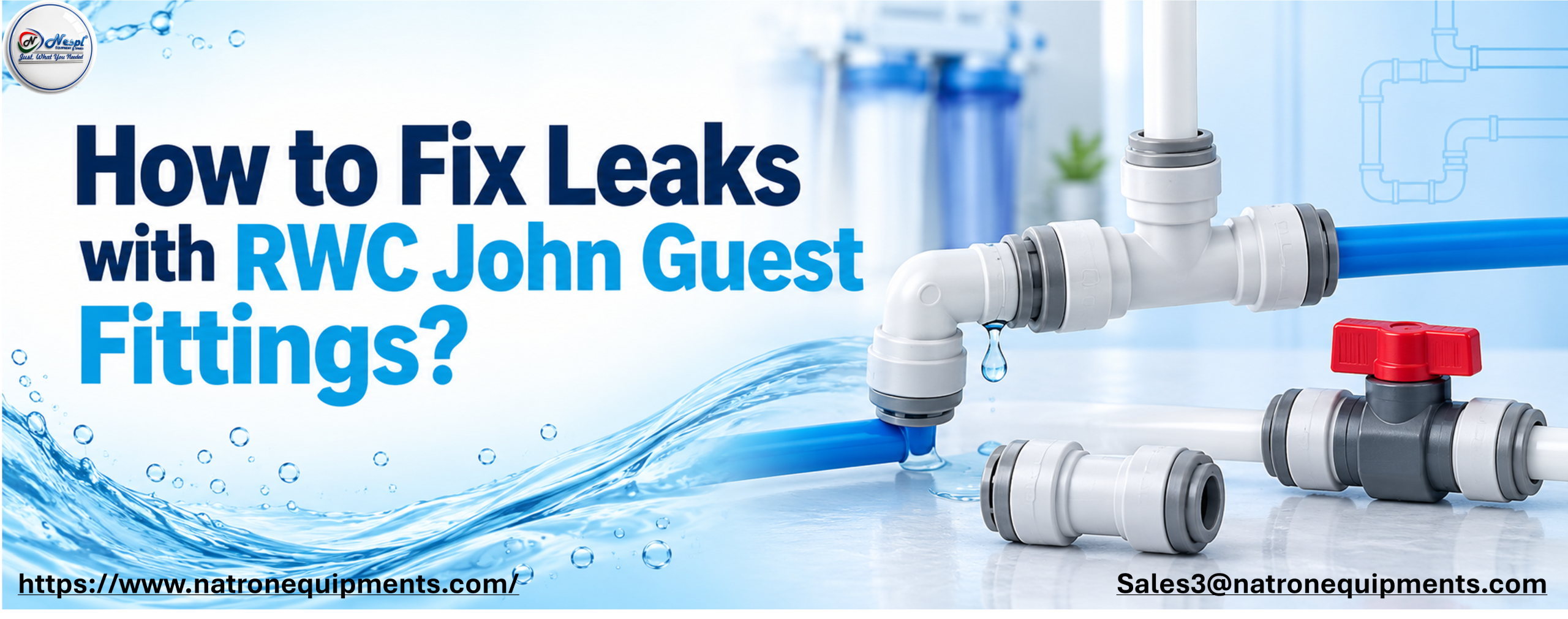
RWC John Guest push-fit fittings are widely used for connecting tubing in water treatment, beverage dispensing, OEM equipment, pneumatics, and other fluid-handling applications. They are designed to make tube connections quick and secure, but a leak can still occur if the tubing is not prepared correctly or the connection is subjected to damage or excessive stress.
For any doubt & Query write us at: sales3@natronequipments.com
In many cases, a leaking John Guest fitting does not mean that the fitting itself is faulty. The problem may be as simple as a tube that has not been pushed in fully, an uneven cut, damaged tubing, incorrect tube size, or dirt around the sealing area.
This guide explains the common causes of leaks and what to check when a RWC John Guest fitting is leaking.
How Does a John Guest Push-Fit Fitting Work?
A typical John Guest push-fit connection uses two important components: the collet and the O-ring.
The collet grips the tubing and holds it in position, while the O-ring seals against the outside surface of the tube. Because the O-ring makes contact with the tube itself, the tube surface needs to be clean, smooth, correctly sized, and free from significant scratches or damage.
A problem with either the tubing or the fitting can therefore affect the connection.
Why Is My John Guest Fitting Leaking?
There are several possible causes of a leaking push-fit connection, including:
- Tube not fully inserted
- Tube cut at an angle
- Burrs or sharp edges on the tube
- Scratched or damaged tubing
- Incorrect tube outside diameter
- Crushed or distorted tubing
- Damaged O-ring
- Dirt or other contamination
- Excessive side load on the connection
- Damaged fitting body
- Incorrect installation
Before replacing the fitting, identify exactly where the water or other fluid is escaping.
1. Make Sure the Tube Is Fully Inserted
One of the first things to check is whether the tube has been pushed far enough into the fitting.
The tube should be inserted fully until it reaches the tube stop. A partially inserted tube may initially feel secure but may not provide a reliable seal.
After inserting the tube, give it a gentle pull to confirm that the collet has gripped it properly. Then check the connection for leakage under the appropriate operating conditions.
2. Check the Tube Cut
The end of the tube should be clean and square. An angled, rough, crushed, or uneven tube end can make proper insertion difficult and may affect the O-ring seal.
After cutting the tubing, check the end for:
- Burrs
- Sharp edges
- Plastic fragments
- Uneven cuts
- Distortion
Do not force a poorly prepared tube into the fitting. If necessary, cut back the tubing and prepare a clean end before reconnecting it.
3. Inspect the Tube for Scratches
The outside surface of the tubing is particularly important because the O-ring seals against it.
Look for deep scratches, score marks, cuts, cracks, flattening, or abrasion around the sealing area. A damaged section can prevent the O-ring from creating a proper seal.
If the sealing area is damaged, remove the affected section where appropriate and prepare a fresh tube end before reconnecting it.
4. Verify the Correct Tube Size
John Guest fittings are designed for specific tube outside diameters. A tube should not be considered compatible simply because it fits into the fitting opening.
Check the fitting size, tube outside diameter, tube material, and application before making the connection.
Extra care is needed when working with similar-looking metric and imperial tubing sizes. Even a small difference in outside diameter can affect the seal.
5. Check for Tube Distortion and Side Load
The tubing should remain round where it enters the fitting. A flattened, crushed, kinked, heat-damaged, or otherwise distorted tube may prevent the O-ring from sealing properly.
Also look at how the tubing is routed. If the tube is too short or is being pulled strongly to one side, it can place continuous sideways force on the fitting.
Correct the tube routing where necessary rather than relying on the fitting to withstand unnecessary side load.
6. Inspect the Fitting and O-Ring
If the tubing is correctly sized, properly prepared, and fully inserted but the connection continues to leak, inspect the fitting itself.
Check the fitting for visible damage and examine the sealing area for contamination or signs of O-ring damage. Dirt or debris around the connection can interfere with the seal.
If the fitting or O-ring is damaged, the appropriate replacement component may be required rather than attempting to correct the leak through additional force.
How to Remake a Leaking John Guest Connection?
If the leak is coming from the push-fit side, the connection may be able to be remade without replacing the fitting. Before disconnecting the tubing, make sure the system is isolated and fully depressurised.
Step 1: Isolate the system
Shut off the water, beverage, air, or other supply connected to the fitting.
Step 2: Depressurise the system
Do not disconnect a push-fit connection while the system is under pressure.
Step 3: Release the tube
Push the collet toward the fitting body and gently remove the tube.
Step 4: Inspect the tube
Check the tube for scratches, burrs, cracks, distortion, or an uneven cut.
Step 5: Prepare the tube
If the sealing area is damaged, remove the affected section where appropriate and make a fresh, clean, square cut.
Step 6: Inspect the fitting
Check the fitting for visible damage, contamination, or problems with the sealing area.
Step 7: Reconnect the tube
Push the tube straight into the fitting until it reaches the tube stop.
Step 8: Check the connection
Gently pull the tube to confirm that it is securely held by the collet.
Step 9: Test for leaks
Restore system pressure according to the equipment procedure and carefully check the connection for leakage.
What About Leaks From the Threaded Side?
Some RWC John Guest fittings combine a push-fit connection with a male or female threaded connection. If fluid appears around the fitting, first determine which side is actually leaking.
- Push-fit side: Check tube preparation, insertion, and the sealing area.
- Threaded side: Check the threaded connection and its sealing requirements.
If the leak is coming from the threaded side, repeatedly removing and reconnecting the tubing will not address the actual source of the leak.
When Should You Replace the Fitting?
Replacing the fitting may be appropriate when the body is damaged, the sealing components are compromised, or the connection continues to leak after the tubing has been correctly prepared and installed.
However, replacing the fitting should not be the first response to every leak. If the actual problem is an incorrectly cut tube, incorrect tube size, incomplete insertion, or excessive side load, installing another fitting may not solve the underlying issue.
Identifying the cause first can save time and prevent unnecessary replacement of otherwise usable components.
How to Prevent John Guest Fitting Leaks
Good tube preparation and correct installation are the most important steps in maintaining a reliable push-fit connection.
Use tubing with the correct outside diameter, make clean and square cuts, keep the sealing surface free from damage and contamination, and make sure the tube is fully inserted. The tubing should also be routed in a way that does not place unnecessary stress on the fitting.
These checks are particularly useful in water filtration systems, beverage equipment, coffee equipment, and other fluid-handling applications where multiple push-fit connections may be operating continuously.
Why Buy RWC John Guest Fittings from NESPL?
When a John Guest fitting needs to be replaced, selecting the correct size and configuration is important. Natron Equipment & Spares Pvt. Ltd. (NESPL) is one of the suppliers of RWC John Guest fittings and fluid-handling components for beverage equipment, water systems, OEM applications, and other professional equipment.
If you are looking to buy RWC John Guest fittings, NESPL can help you identify and source the required product based on details such as the fitting type, tube outside diameter, connection size, existing part number, application, or a clear photograph of the current fitting.
NESPL works with OEMs, equipment manufacturers, distributors, service centers, and commercial businesses that require John Guest fittings and other fluid-handling components. For businesses with regular requirements, NESPL can also support bulk orders based on product availability and required quantities.
Once the required fitting has been identified, NESPL can assist with purchasing and shipping, helping customers receive the correct component safely and as soon as possible. Installation and troubleshooting should be carried out by the appropriate technician or trained professional.
Conclusion
A leaking RWC John Guest fitting does not necessarily mean that the fitting itself needs to be replaced. In many cases, the cause can be traced to the tubing, such as incomplete insertion, an uneven cut, scratches, incorrect sizing, distortion, or excessive side load.
Start by checking the tube and connection carefully before replacing any components. If the fitting or its sealing components are damaged, replacement may be necessary.
If you need to buy RWC John Guest fittings or other fluid-handling components, Natron Equipment & Spares Pvt. Ltd. (NESPL) can help you identify and source the required product and arrange safe, prompt shipping according to availability and your requirements.